
We Never Outgrow Play
Rethinking play not as recreation, but as a lifelong necessity for health, connection, and resilient communities.

Recently, while reading an article in CLAD on the growing movement to treat playgrounds as civic infrastructure, I was struck by how much the conversation around play has evolved. Increasingly, research confirms that play is not reserved for childhood. It is a biological and social necessity that supports human well-being across each phase of life.
For children, the benefits of play are profound. In Last Child in the Woods, Richard Louv warned that disconnection from nature carries measurable developmental consequences. Neuroscience research now reinforces this idea, showing that children deprived of free, unstructured play often develop weaker stress-management skills and less robust neural pathways tied to creativity, emotional regulation, and problem-solving.
But the importance of play does not disappear with age. Stuart Brown, founder of the National Institute for Play, has argued that play remains essential throughout adulthood, supporting adaptability, emotional well-being, and social connection. Adults who engage in playful activities consistently report greater life satisfaction and lower stress levels. Public health research echoes this, with organizations like the American Academy of Pediatrics emphasizing that play strengthens relationships, buffers against toxic stress, and contributes to healthier communities overall.
Even across species, play appears deeply tied to survival and adaptability. More playful animals tend to be more socially connected and more capable of responding to change. In humans, the same principle seems to hold true. The conditions that support play, movement, curiosity, immersion in nature, exploration, social interaction, are often the very same conditions that support a life well lived.
And yet, despite mounting evidence, modern environments rarely prioritize play in daily life. A global study found that 78 percent of children believe adults do not take play seriously. Perhaps that’s because we continue to think of play as something separate from everyday living: an activity confined to designated playgrounds, scheduled recreation, or childhood alone.
What is beginning to shift, and what the CLAD article reflects, is a growing recognition that play spaces are not merely amenities. They are essential civic infrastructure that contribute to public health, social cohesion, and even climate resilience. But perhaps the more meaningful shift is understanding that truly healthy communities do not simply provide places for play. They create the conditions where play naturally emerges.
In Serenbe, we did not set out to create playgrounds so much as to create a place where play could become part of everyday life. That distinction matters, because play is not confined to a fenced area or defined by equipment. It happens organically when people are connected to nature and to one another.
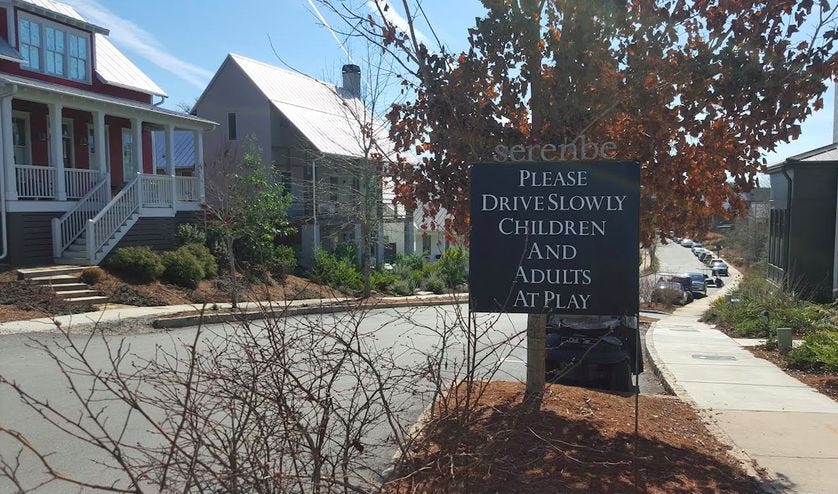
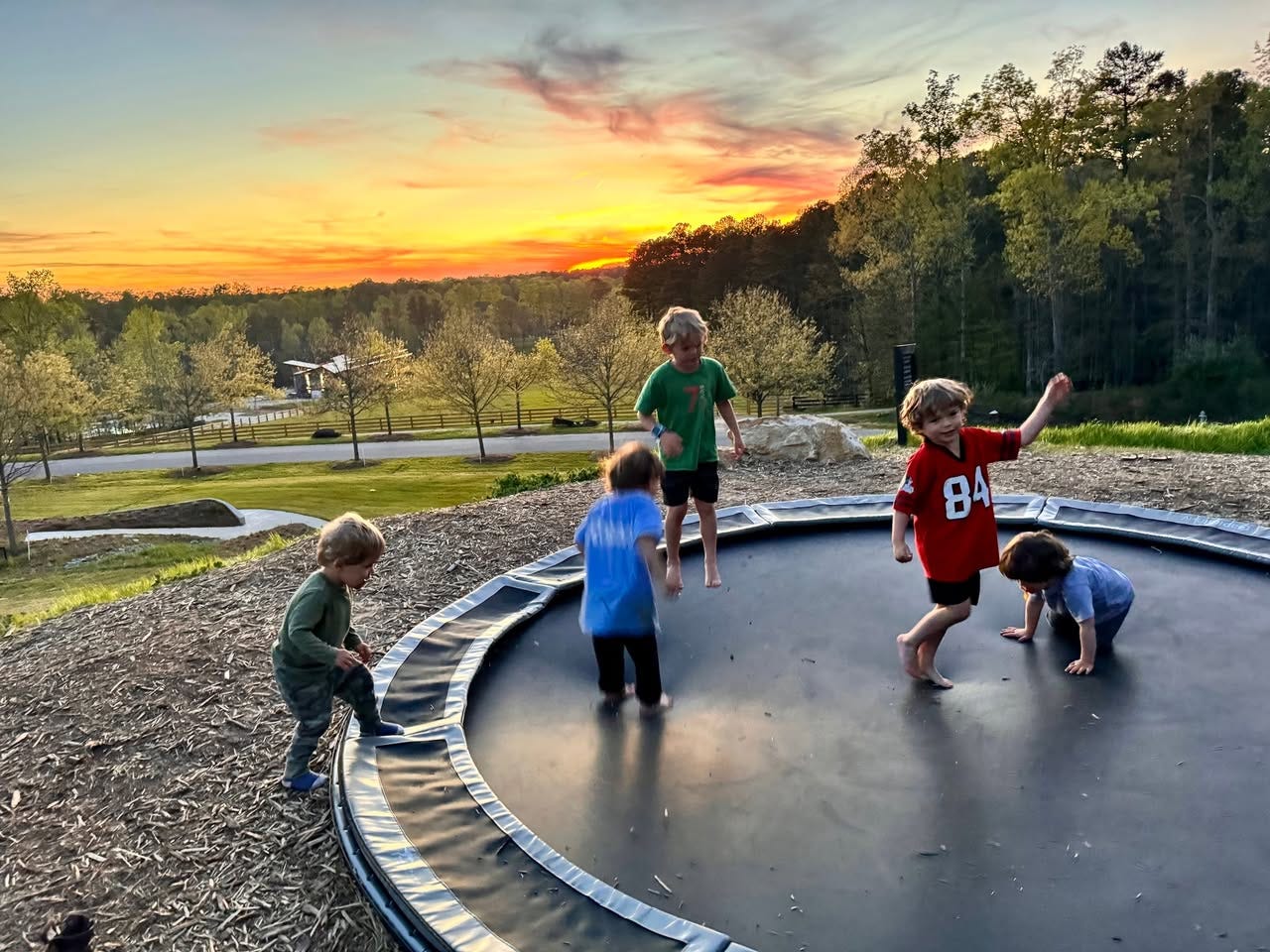
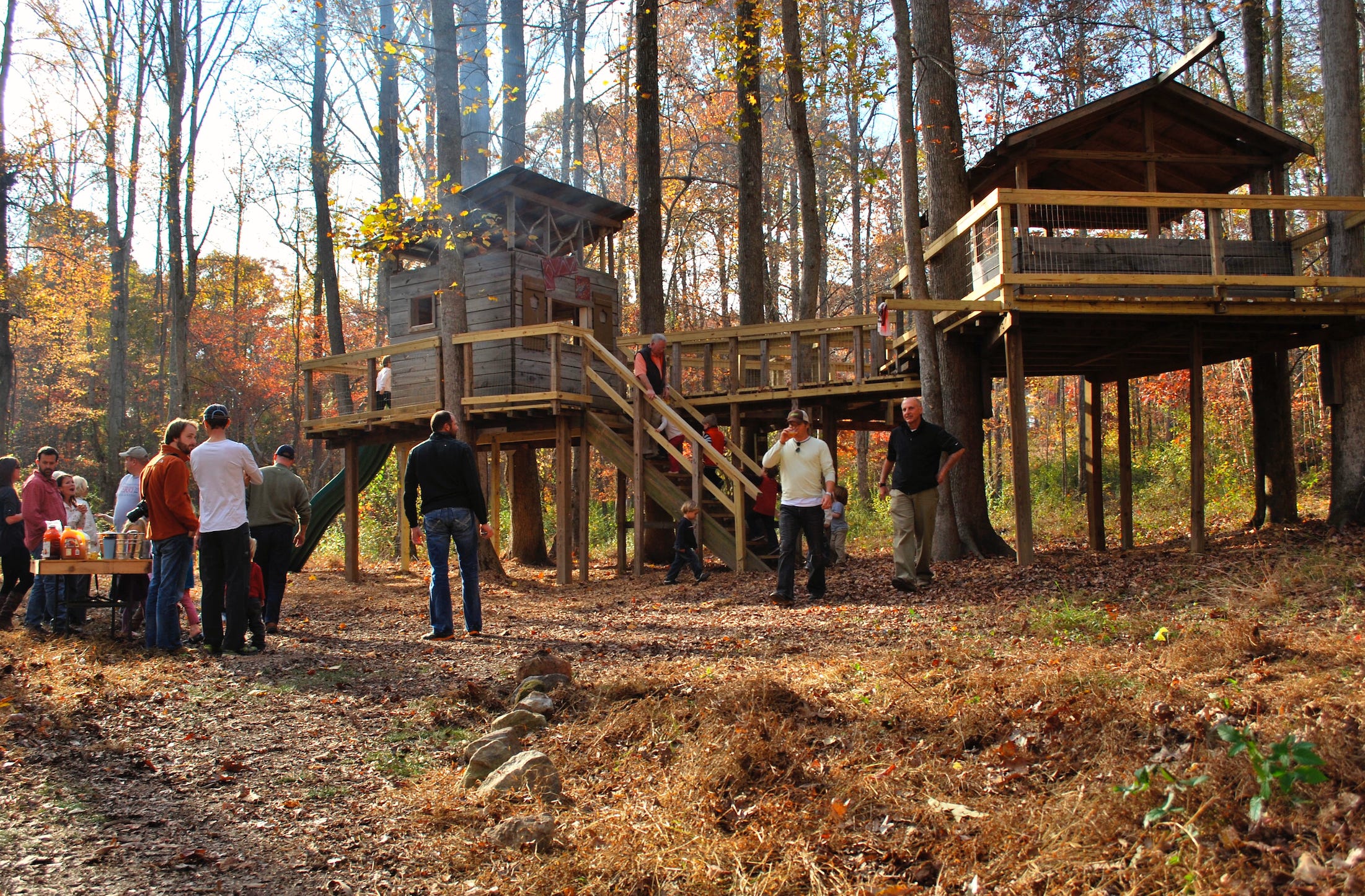
From the moment you enter Serenbe, the philosophy is visible. Traffic signs read, “Drive Slowly, Children and Adults at Play.” Not just children, adults too. Throughout the community, opportunities for play appear in subtle and unexpected ways: trampolines set into the ground near gathering spaces, swings hanging among trees, treehouses tucked into the woods, slides emerging from the landscape, trails weaving between homes, farms, and commerce. None of it is labeled “play infrastructure,” and yet all of it encourages movement, spontaneity, and connection.
Our newest hamlet, Spela, expands on this idea. Named after the Swedish verb meaning “to play,” whether playing a game, an instrument, or performing, Spela reflects a broader understanding of play as creativity, expression, movement, and joy. The hamlet is organized around a four-acre park designed for all ages, with spaces for children, movement equipment that supports aging bodies, meditation gardens, pollinator habitats, and quieter natural edges that encourage reflection and connection.
Two decades ago, much of this approach was guided by instinct, observation, and a belief in the importance of human connection to nature. Today, science increasingly affirms it. Communities that embed play into daily life are not simply more enjoyable. They are healthier, more resilient, and more connected. And perhaps most importantly, they remind us of something we have always known: we are at our best when we never stop playing.
